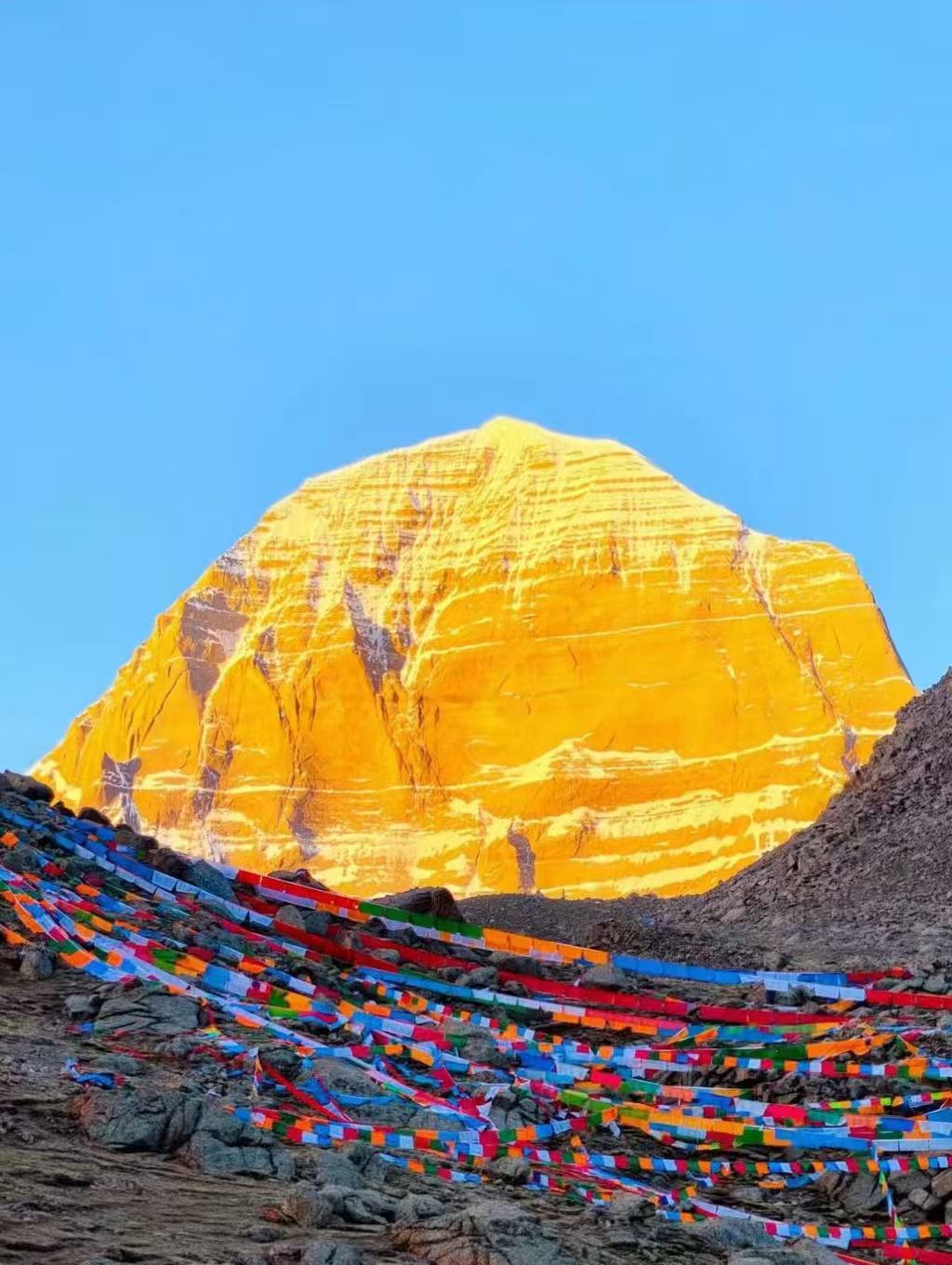
Mount Kailash is not the kind of mountain people come to climb.
The usual goal is to walk around it.
The 52-kilometre kora takes most people three days, although the pace depends a lot on altitude, weather and how much time you have. The route starts and finishes near Darchen and crosses the high Drolma La pass before dropping into the valley on the other side.
It is a tough walk, but the landscape changes constantly. You start with wide open valleys, get into rougher mountain terrain on the second day, and then spend the last day walking back towards Darchen.
Starting from Darchen
Darchen is the usual starting point for the Kailash kora.
Before starting, it is worth taking things slowly here. This is already a very high-altitude area, and the trek itself is not the place to test how quickly you can walk.
The first part of the route is relatively straightforward. The trail follows the valley towards the north side of Mount Kailash, with the mountain gradually becoming more prominent.
There are plenty of other pilgrims on this section, especially during the main pilgrimage season. Some walk quickly, while others stop often to pray, rest or leave offerings along the way.
The first day's destination is generally around Dirapuk.
Day 1: Darchen to Dirapuk
The first day is roughly 12–13 km, depending on the exact starting point and route.
This is probably the easiest day of the kora, but the altitude makes even a normal walking pace feel different.
The trail passes through a broad valley, and Mount Kailash slowly comes into view. Near Dirapuk, the north face of Kailash is one of the main highlights of the whole trek.
This is a good reason not to rush the first day.
The scenery changes as the valley gets narrower, and by the time you reach Dirapuk, the mountain feels much closer than it did in the morning.
There are basic accommodation and food options around the overnight area, but don't expect the comfort of a normal hotel. Conditions are simple, and it is better to arrive with realistic expectations.
Day 2: Dirapuk to Zuthulpuk
The second day is the difficult one.
The route climbs steadily towards Drolma La, the highest point of the kora at around 5,630 metres.
This section is where altitude becomes the biggest challenge. The climb is not technically difficult, but the combination of steep sections, loose ground and thin air makes it slow going.
Take your time.
There is no prize for reaching the pass first.
Drolma La is marked by prayer flags and other religious objects left by pilgrims. After reaching the pass, the trail descends sharply. The descent can be just as tiring as the climb, especially when the ground is uneven.
One of the notable places on this section is Gauri Kund, a small turquoise lake below the pass.
After the pass, the landscape gradually becomes less steep as the trail continues towards Zuthulpuk.
The second day is usually the longest and hardest part of the kora, so having enough water, warm clothing and snacks makes a real difference.
Day 3: Zuthulpuk to Darchen
The final day feels very different.
After the difficult crossing of Drolma La, the trail gradually becomes easier. The route follows the valley towards the end of the kora, with fewer steep sections than on the previous day.
The final stretch is around 8–10 km, depending on the exact route.
Eventually, the trail reaches the road near Darchen, where vehicles can pick trekkers up.
And that's it.
After three days of walking around one of the most remote and sacred mountains in Tibet, getting back to a normal road feels surprisingly good.
What makes the Kailash kora difficult?
The distance itself isn't the biggest problem.
We also wanna know how to complete the Mount Kailash Trek?
Most people who struggle on the kora are dealing with the combination of high elevation, long walking days and the steep climb to Drolma La.
That is why spending enough time acclimatising in Tibet before coming to the Kailash region is important.
The weather can also change quickly. Even in warmer months, mornings at this altitude can be cold, and conditions around Drolma La can be very different from those in Darchen.
Good walking shoes, warm layers, sun protection, water and basic snacks are worth bringing.
A few practical things to know
The Kailash kora is remote.
Don't expect a normal hiking trail with restaurants, toilets and comfortable mountain huts every few kilometres. Facilities become very basic once you are away from Darchen.
It is also worth remembering that this is a pilgrimage route as much as it is a trek. You'll see people making the circuit in very different ways, including pilgrims who prostrate themselves along the entire route.
For a first visit to the region, it makes sense to have the transportation and permits arranged before reaching Darchen. The Kailash area is remote enough that trying to organise everything at the last minute can make things unnecessarily complicated.
Is it worth doing?
If you are looking for an easy Himalayan hike, probably not.
If you want a route with huge mountain scenery, a strong sense of place and something that feels very different from a standard sightseeing trip, the Kailash kora is hard to beat.
The three days are physically demanding, especially the second day, but you don't need to be a technical climber. The main requirements are patience, preparation, and enough time to adjust to the altitude.
The best part is that the route doesn't feel like a normal tourist attraction.
For most of the trek, you're simply walking through a high-altitude landscape with Mount Kailash in the background, alongside pilgrims who have travelled a very long way to be there.
That's what makes the kora memorable.

